
BREMERTON — Port of Bremerton commissioners agreed Nov. 10 to keep studying commercial passenger service at Bremerton National Airport, with the understanding that the port would look to the state, the Navy, private partners and others to pay for it.
No vote was taken. After a presentation from consultant Kevin Nuechterlein of Mead & Hunt and Nicholas Mirra of Maul Foster Alongi, the three commissioners told staff to move toward a third phase of the airport feasibility study. CEO Jim Rothlin said the port’s lobbyists will ask the state to fund that phase, as it has funded earlier ones, and that work will not go beyond any money left in the current study budget until new funding is secured.
Rothlin said the next phase has no impact on the port’s 2027 budget.
“The port isn’t gonna make money on this, but we can’t afford the financial burden of doing this,” Rothlin said. He added that airlines typically require revenue guarantees from the communities they serve. “We can’t afford to take a million-dollar operational hit.”
Consultants have put the near-term cost of starting service at about $21 million, and long-term development at more than $100 million. Commission President Cary Bozeman said that is far beyond what the port, which he described as a $12 million-a-year operation, could pay on its own.
“So if there’s not funding available, then that answers the question,” Bozeman said. He also said the public should not expect the service to be a moneymaker: “I don’t think the public ought to think we’re doing this to make money, because we’re not.”
Commissioner Axel Strakeljahn urged the consultants to include public-private partnerships on their list of potential funders, naming Propeller Airports, which built and operates the passenger terminal at Paine Field in Everett. Nuechterlein said he had tried to arrange a meeting with the company but had not been able to.
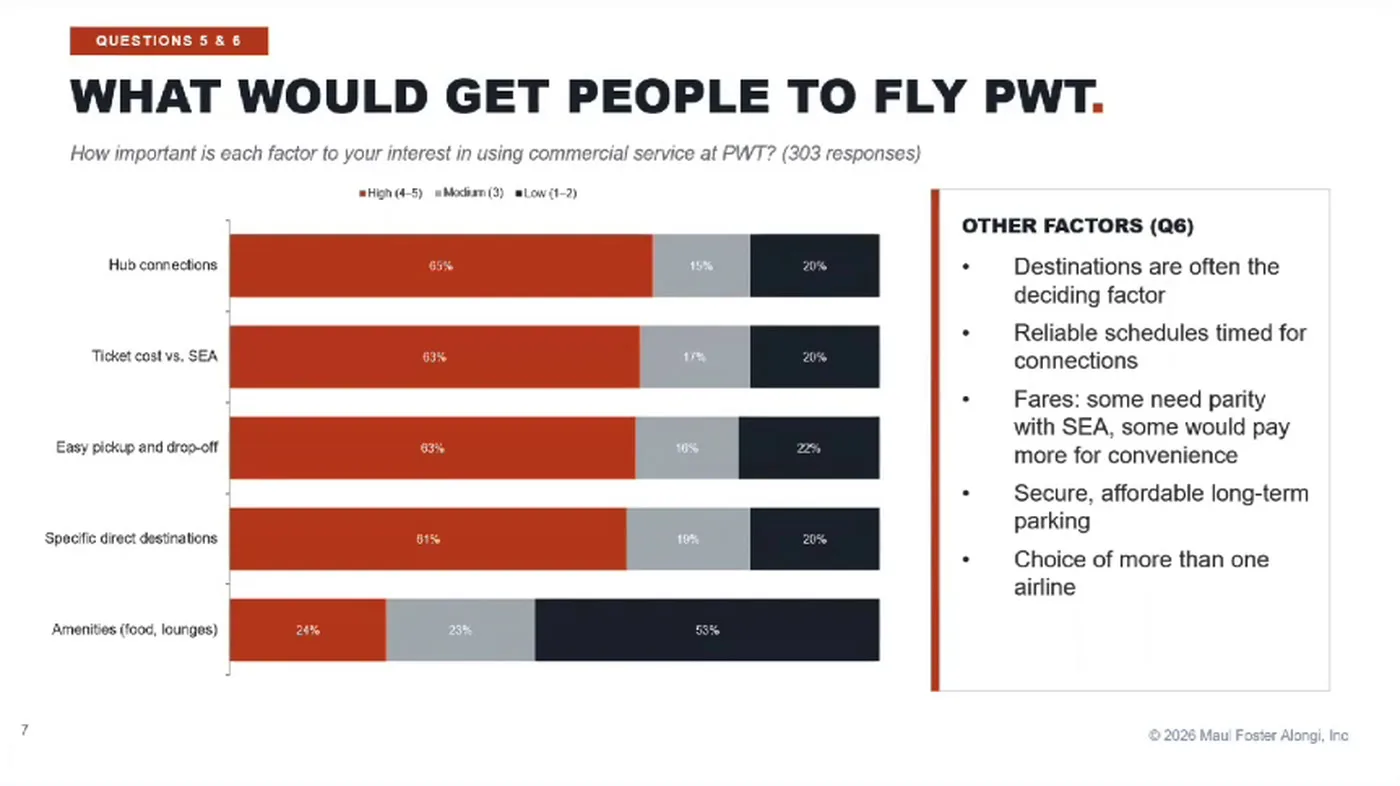
A fall public survey drew 310 responses, far fewer than an earlier round. Mirra, whose firm ran the outreach for Mead & Hunt, said about a quarter of written comments clearly supported commercial flights, about a quarter opposed them or raised concerns, and almost half asked for more information. Of the respondents, 144 asked to keep getting updates.
Being close to home instead of driving to Sea-Tac was the benefit people valued most. Cost to local taxpayers was the top concern, followed by traffic, environmental impacts and noise. The consultants said the survey was not a statistically valid sample, noting that nearly 75% of those who answered an income question reported household incomes of $100,000 or more.
Early research pointed to low-cost carriers flying to Sun Belt destinations such as Phoenix, Las Vegas and San Diego, according to the consultants. At full buildout, about 20 years out, the scenarios shared with the public called for at most about five flights a day.
Airport Manager Cole Barnes said the runway would not need to be lengthened. The main initial change would be widening the taxiway by several feet on each side to meet federal standards for commercial aircraft. A control tower would not be required, he said, and the current terminal building would be retrofitted to serve as a temporary passenger terminal.
“I think it would be a disservice to our community” not to keep looking, Barnes said.
The proposed third phase is broken into steps that would let the port stop at any point. They include an implementation schedule, an estimate of operating costs and revenues, briefing materials aimed at funders, more community outreach and, only if the community supports it, more detailed planning with the Federal Aviation Administration.
Bozeman, who pointed to population growth on the Kitsap Peninsula, said the port needs to plan decades ahead. “Will we need this kinda service 20 years from now? Probably,” he said.
The meeting recording is available on BKAT at https://bremerton.vod.castus.tv/vod/?video=b69881e1-5e8f-48be-a2ba-817a81574ab1.

Leave a Reply