
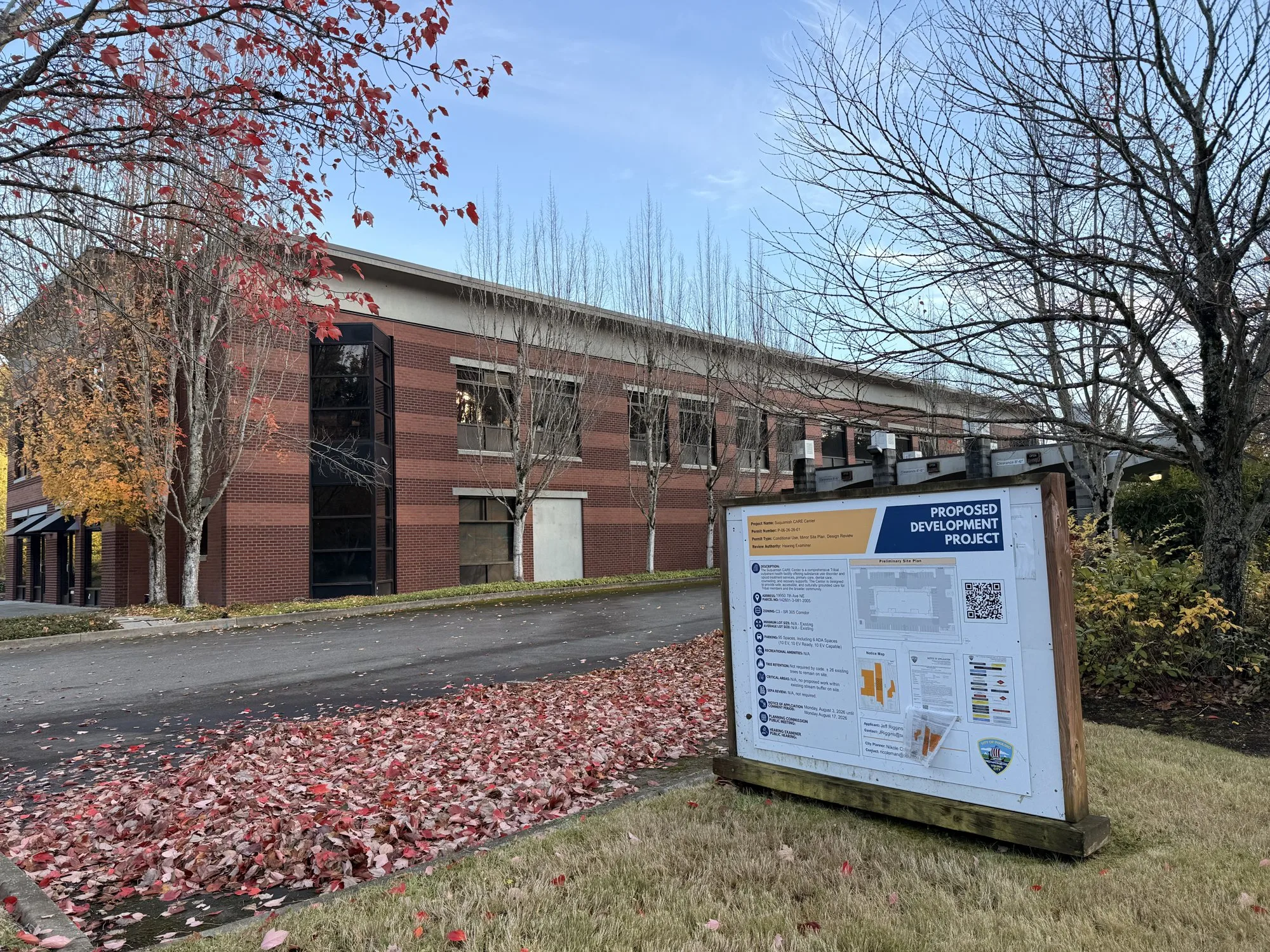
POULSBO — The Poulsbo Planning Commission has recommended approval of the Suquamish Tribe’s plan to turn a former bank building near Highway 305 into a regional outpatient clinic offering opioid treatment, primary care, dental care and behavioral health counseling. The final decision goes to the city’s hearing examiner, who will hold a public hearing at 10 a.m. Thursday, Dec. 3.
Commissioners voted 6-0 Oct. 27 to send the Suquamish CARE Center permits to the examiner with the conditions recommended by city staff, plus one added that night making the Tribe responsible for bringing the existing sidewalk frontage along the property up to Americans with Disabilities Act standards. Commissioner Ray Stevens made the motion and Commissioner Ray Taylor seconded it. Commissioner David Strickon was absent.
The clinic, at 19950 7th Ave. NE, would open serving about 75 to 100 patients a day and could grow to about 200, Planning Manager Nikole Coleman told the commission.
The project has drawn little public attention. Coleman said the city received no written comments from residents or other agencies, including during a comment period in August. “We received zero public comments, which blows my mind a little bit,” she said. The Poulsbo Police Department reviewed the application and had no comments, according to the staff report.
One resident spoke at the Oct. 27 meeting. John Giacomi of Poulsbo said he was generally supportive of addiction treatment but asked whether the clinic would serve only tribal members and what would happen if crime or disruptive activity increased nearby.
Jeff Riggins, the Tribe’s community health program manager, answered that anyone seeking the clinic’s services may use it, tribal member or not. He said the Tribe does not expect problems such as loitering or car break-ins, which he associated with older methadone clinics, because opioid treatment programs are tightly regulated by federal agencies. If problems arise, he said, the Tribe would work with the Poulsbo police and fire departments, which it has already begun talking with.
What’s planned
The clinic would be open Monday through Saturday from 5:30 a.m. to 6 p.m. and closed Sundays. Appointments would be scheduled and staggered, and all waiting would happen inside the building. About 40 people would work there at full operation. The Tribe expects about 20% of patients to arrive by tribal shuttle.
The building, nearly 31,000 square feet, was built in 1995 as the Rayonier Building and later housed a bank and offices. The remodel would remove the drive-through, move the main entrance to the 7th Avenue side and add cedar siding and tribal design elements. The site would have 95 parking spaces and a drop-off area for shuttles. That is 7.8% fewer spaces than city code would otherwise require, a reduction city staff approved.
A June traffic study by Heath & Associates estimated the clinic would generate about 556 vehicle trips on an average weekday, fewer than the former bank and offices, so no full traffic impact analysis was required.
Riggins said construction is expected to start early next year and finish near the end of 2027. The Tribe is also seeking LEED green building certification.
Security
The Tribe’s security plan calls for exterior lighting, cameras covering the entrances, exits and parking lot, and staff on site during all operating hours. Riggins told the commission there will also be a “dedicated security presence and expansive camera coverage” to prevent loitering and monitor the building.
Staff’s recommended conditions would make those measures binding. They require patients to wait inside, direct the operator to discourage loitering, and require a designated contact for neighbors’ concerns. If the city documents recurring security problems tied to the clinic, the operator must meet with the city to work out fixes.
Security for medications and controlled substances will be handled through separate federal and state licensing by the U.S. Drug Enforcement Administration, the Substance Abuse and Mental Health Services Administration and the Washington State Department of Health, and is not part of the city’s review.
Why Poulsbo
The Suquamish Tribal Council declared an opioid crisis in the Suquamish community at the end of 2023. The Legislature provided $18.48 million in the state capital budget to buy and remodel the building, according to the Tribe.
“The opioid crisis is already here. The question is whether we respond with distance and fear or with structure, care, accountability and healing,” Riggins told commissioners. “The Suquamish Tribe is choosing care.”
Riggins said the Tribe has offered medication-assisted treatment for more than a decade and modeled the center on programs other Washington tribes run that combine opioid treatment with primary care, dental care and counseling. He said clinic revenue “is healthcare money” and will be reinvested in health services, not other tribal businesses. CARES stands for Comprehensive Access to Resilience and Empowerment by Suquamish.
Asked on its website whether the center is a methadone clinic, the Tribe says it is “more than a narrowly defined methadone clinic” and that methadone is one of the FDA-approved medications that may be used in a licensed opioid treatment program.
Why it needs a hearing
The property is zoned for commercial use along the Highway 305 corridor. The city classifies the center as a regional essential public facility, a state Growth Management Act category that includes substance use disorder treatment facilities, because its opioid treatment program will serve people beyond Poulsbo. That requires a conditional use permit. The project is exempt from state environmental review because it reuses an existing building.
How to comment
The hearing examiner’s public hearing is at 10 a.m. Thursday, Dec. 3, or as soon after as the agenda allows, in the City Council Chambers at Poulsbo City Hall, 200 NE Moe St. People can also join online at us06web.zoom.us/j/86468838536 or by phone at 253-215-8782, meeting ID 864 6883 8536. Anyone may testify in person or online. Written comments can be mailed, emailed or delivered to the city’s Planning and Economic Development Department, 200 NE Moe St., Poulsbo, WA 98370, or plan&econ@cityofpoulsbo.com, and must arrive before the hearing closes. Reference file P-06-26-26-01.
Leave a Reply